The over-use of technology has been rapidly growing not only in America, but all over the world, over the last few years. Because of this, it’s extremely important (perhaps even detrimental to our society as whole) to find the time to take breaks from our devices throughout the day. However, app developers and web-designers have made that nearly impossible to do, as most of their designs double as strategic attempts to keep users’ attention for an extended amount of time. Re-designing these apps, like Youtube, Instagram, Twitter and Facebook – is the best way to help people manage their time more effectively and create time for something other than using their devices/the internet. “More than 2 billion people own smartphones, with that number expected to reach 2.87 billion in 2020. In the United States, smartphones have grown increasingly common over the last seven years. According to the Pew Research Center, 77 percent of American adults own smartphones, up from 35 percent in 2011. A whopping 94 percent of people aged 18–29 own smartphones, as do 89 percent of people aged 30–49 and 73 percent of people aged 60–64. There’s no truly significant drop until you hit 65 and older, but even then, the ownership number is still 46 percent.” (Source) As this information states, more and more people are starting to use smartphones and at younger and younger ages. This just further illustrates why it’s so important for everyone (app developers and their consumers) to start forming better habits when it comes to tech device usage.
“But we all know how hard it can be to get off the internet once we’re plugged in: In fact, a study in 2014 found that 6 percent of the global population suffered from full-blown internet addiction.” (Source) This article perfectly encapsulates why it’s important to step away from our phones, laptops and tablets. Using the internet and social media apps is addictive and when we’re encouraged to keep using them, but to not hold ourselves or the designers/developers accountable for how much time we’re spending on their apps or websites, we continue without really thinking about how much it’s costing us. “Harris, a former participant in Stanford University’s Persuasive Tech Lab, said in his TED conference speech that tech designers know exactly how to manipulate people into keeping their eyes on the screen: “There’s conferences and workshops that teach people all these covert ways of getting people’s attention and orchestrating people’s lives. And it’s because most people don’t know that that exists that this conversation is so important.” (Source) I’ve certainly spent hours scrolling through multiple websites. Twitter, especially in the time of political and social unrest, a global pandemic and even “murder hornets,” became almost addictive for me for several weeks. I constantly found myself checking the “trending pages” and scrolling endlessly through other users’ fights with each other about whether or not COVID-19 is real, seeing what everyone else around the world was doing while they were quarantining and even when my favorite sports teams were going to be coming back (if they were going to ever be coming back at all). I feel like some of this anxiety and constant social media-checking has carried over into the seventh month of the pandemic, so I still find myself constantly on social media as it’s my main source for news and I feel like I don’t want to miss anything these days.
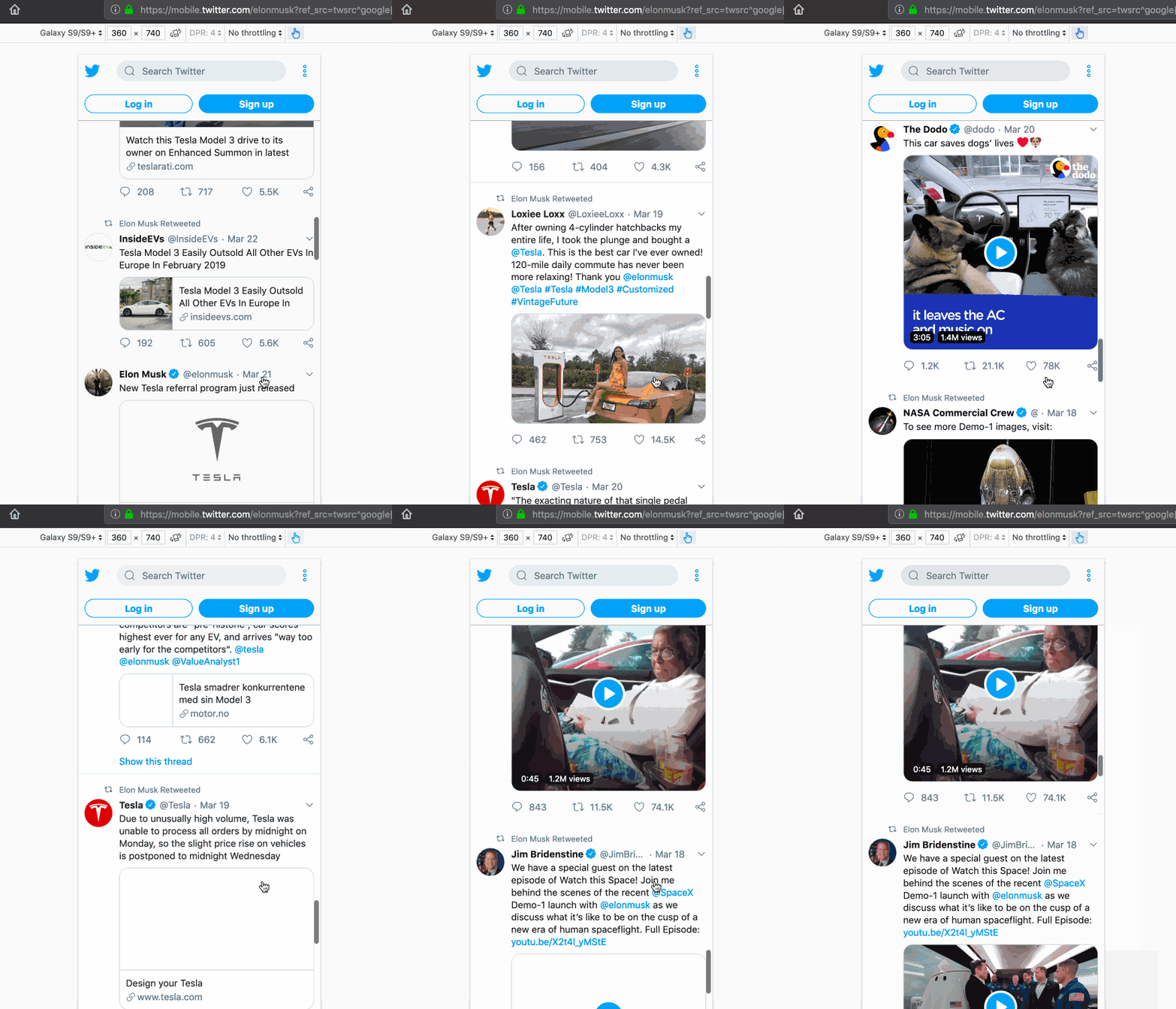
Seeing as though Twitter is one of the apps I use the most, I think that it could do with a bit of a re-design when it comes to the interface, how people are allowed to interact with one another and what is allowed to be shared on the platform. One of the things I noticed while using the app throughout quarantine was that sometimes, as the user scrolls through their timeline or another user’s profile (at least, on an iPhone XS) the time will disappear from the upper left corner of the device. This often allows me to scroll for several minutes at a time without thinking about how much time I’m spending looking through news, memes and everyone else’s political opinions. Changing this to having the time showing at all times would surely help me, as well as others, keep track of how much time they’re spending on the app. Twitter also uses the “endless scroll” feature which enables user to scroll through their timelines without the page ever stopping. Making this a page that only shows 15-20 Tweets at a time might help break up how much time users are spending endlessly scrolling. Twitter is also known amongst it’s more frequent users as a fairly toxic place where people tend to not just engage in discourse, but even participate in full on heated arguments where threats are sometimes exchanged between the two (or more) participants. I’m aware that Twitter does have policies in place to try to prevent this type of behavior on the platform, however, it does seem to go unpunished in a lot of cases. Having stricter policies might prevent this from happening. Lastly, Twitter also has a problem with graphic images and videos being shared on the website. Though, some things do also get flagged as being graphic when they aren’t. I feel that having better A.I to detect these kinds of things, as well as having a better, faster system for review would help solve this problem or at least improve it a bit. In our society today, I think it’s more evident than ever that many people are desensitized to how much time they’re spending on their smartphones, which often causes more loneliness and isolation than it offers more space for community and interaction with others.

Another problem I’ve noticed as I’ve been frequenting Twitter for the last few months, is a lot of people are also desensitized to the news we read and hear everyday. Especially with people who are my age and younger (who can read and comprehend the news, so perhaps from ages 15-30), I find that they become interested in political causes or movements due to a tragic event they’ve heard about (or even just an event in general, maybe it doesn’t necessarily have to be tragic) and then they don’t follow through with the activism that needs to continue after they initially become interested in the cause/movement. Either this happens, or they never become interested at all and try to stay away from the news as much as they can so as to not be made uncomfortable by it. This perhaps the more unfortunate scenario of the two because people need to help other people, that’s one of the core foundations of our humanity. However, social media tends to allow us to back away from this and keep it at a distance because we’re able to turn our devices on and off or even “mute” things we don’t wish to see or hear. I think that apps like Twitter, YouTube and Facebook are all important for sharing what’s happening to people in the current political climate as well as just in society in general. However, they can be untrustworthy due to the fact that anyone can post anything and anyone can then share that information to hundreds of people who might also share it to hundreds of more people. I think it’s important to not only be informed about what’s actually going on in our communities, as well as globally, but to also genuinely care. As humans, we can’t possibly keep track of every tragedy everyone else in the world will face, but we can at least care and try to do our best to help those who are in need, whether they’re close to us or somewhere across the world.
 Gavin Allen
Leave a comment